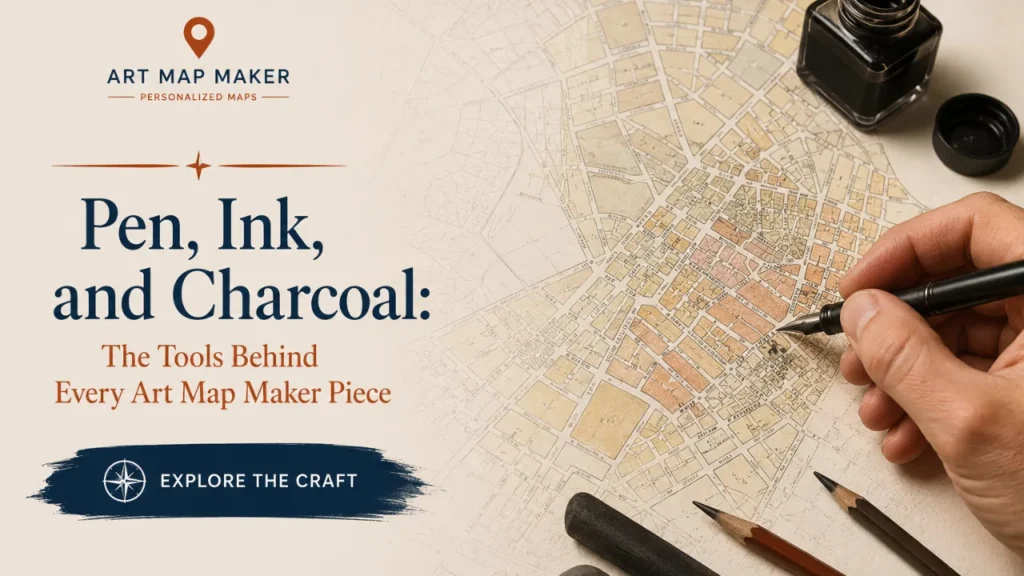
Every hand-drawn map begins long before a single line appears on paper. It begins with tools that have remained largely unchanged for centuries: pen, ink, charcoal, and precision drafting instruments.
These are not just materials. They are extensions of the cartographer’s hand. Each one plays a specific role in transforming geography into fine art.
At Art Map Maker, these traditional tools are still central to the creative process, reinforcing a commitment to hand-drawn cartography rather than automated or digital map generation.
Why Tools Still Matter in a Digital World
In modern design, most creative work happens on screens. Software can generate lines, adjust typography instantly, and correct mistakes with a click.
But in traditional cartography, tools behave differently.
They slow the process down. They introduce discipline. They require intention.
When you draw a line with ink, there is no undo button. When you shade with charcoal, texture becomes something you build gradually, not something you apply with a filter.
This physical limitation is not a disadvantage. It is what gives the work depth.
The Pen: Where Every Map Begins
The pen is the most important tool in hand-drawn cartography.
It defines structure, clarity, and precision. Every coastline, road, boundary, and contour begins as a controlled ink line.
Unlike digital brushes, a pen does not adjust itself. Pressure, angle, and movement all matter. A slight variation can change the character of an entire section of the map.
That is why pen work requires experience. It is not just drawing. It is control.
Over decades of practice, the hand learns consistency, rhythm, and restraint. Those qualities cannot be automated.
Ink: The Medium of Permanence
Ink gives a map its finality.
Once applied, it becomes permanent. It anchors the drawing in time.
In traditional cartography, ink is used not only for outlines but for typography and structural hierarchy. Darker tones establish importance. Lighter strokes guide the eye. Every mark contributes to visual order.
Unlike digital color, ink cannot be infinitely adjusted. That limitation creates clarity of decision-making.
A map drawn in ink reflects confidence. Every stroke is intentional because every stroke is permanent.
Charcoal: The Foundation of Depth
Before ink defines the final structure, charcoal often plays a quieter role.
It is used in early composition stages to establish balance, proportion, and layout. It allows the cartographer to explore structure without committing permanently to detail.
Charcoal is forgiving. It can be adjusted, softened, or erased. This makes it ideal for building the foundation of a map before final ink work begins.
It is where composition is tested. Where scale is adjusted. Where visual rhythm is refined.
Without this stage, the final ink work would lack structure.
Mechanical Lettering: Precision Without Losing Character
Typography is one of the most overlooked elements in cartography.
In traditional mapmaking, lettering is not typed. It is constructed.
Mechanical lettering tools ensure consistency while still preserving a human feel. Each label must fit into the map’s visual hierarchy without overpowering geography itself.
The goal is not decoration. The goal is clarity.
A well-lettered map guides the viewer naturally, without forcing attention. It becomes readable without becoming loud.
Layering the Map: A Structured Process
Every Art Map Maker piece follows a layered approach.
- Composition begins with charcoal structure
- Geography is refined through sketching and adjustment
- Ink defines permanent structure
- Lettering is added with mechanical precision
- Shading introduces depth and texture
- Final refinement balances the entire composition
Each stage builds on the last. Nothing is rushed. Nothing is automated.
This step-by-step process is what separates hand-drawn cartography from mass-produced map prints.
Why Handmade Tools Create Emotional Value
The tools themselves do not just shape the artwork. They shape the experience of creating it.
When working with pen and ink, every decision feels present. There is no background automation. There is only hand, material, and surface.
That physical interaction creates a connection between artist and map that digital tools cannot replicate.
And that connection is visible in the final piece.
You can see where pressure changed. Where texture built up. Where decisions were made slowly and deliberately.
Those subtle details are what give a hand-drawn map its emotional weight.
A Craft Rooted in Discipline
While modern design emphasizes speed and iteration, traditional cartography values patience.
A single map can take days or even weeks to complete, depending on complexity. Not because the process is inefficient, but because every layer requires attention.
At Art Map Maker, this discipline is intentional. It preserves the integrity of the craft and ensures that each piece reflects the philosophy of hand-drawn, heritage-driven mapmaking rather than automated production.
Why These Tools Still Matter Today
In a world of instant visuals, the value of traditional tools is not nostalgia. It is intention.
Pen, ink, and charcoal force the artist to slow down. They require thought before action. They reward precision over speed.
And that is exactly what gives hand-drawn cartography its lasting power.
Because when a map is made with tools that cannot rush, the final result carries something rare:
Time, captured on paper.