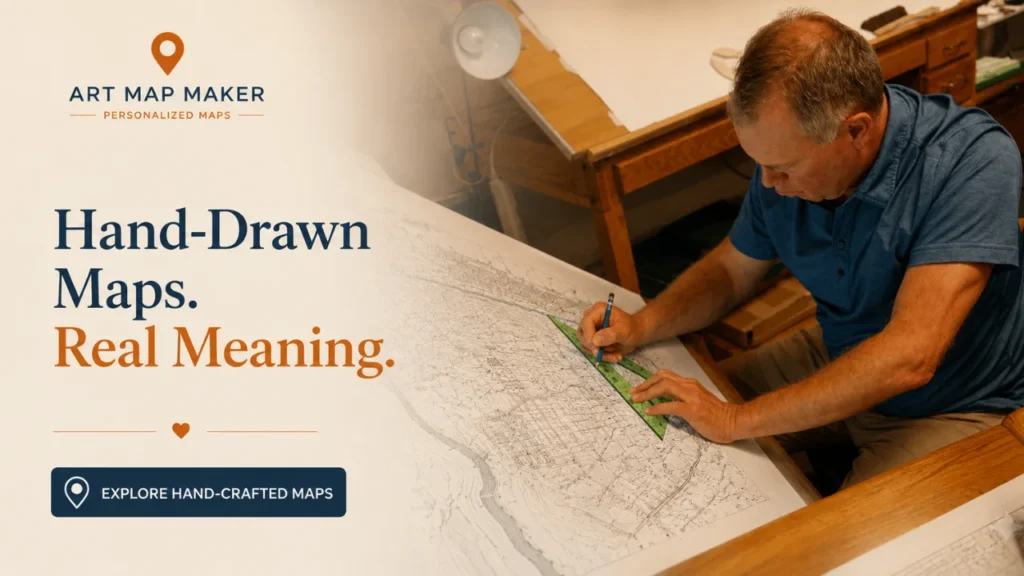
Hand-drawn cartography is the art of creating maps entirely by human hand, using traditional drawing techniques like pen-and-ink illustration, mechanical lettering, and manual shading. Unlike digital or AI-generated maps, every line is intentionally placed by an artist who studies geography not just as data, but as meaning, memory, and design.
In a world where maps are now generated instantly by software, hand-drawn cartography stands apart as something slower, rarer, and far more personal. It is not about speed or automation. It is about interpretation, craft, and emotional depth.
At Art Map Maker, this approach defines everything. Each map is created through traditional cartographic methods refined over decades, rooted in a philosophy that geography should be preserved as fine art rather than reduced to automated visuals.
Cartography Before It Became Digital
Before GPS, satellite imaging, and mapping software, every map in history was drawn by hand. Explorers, surveyors, and cartographers would study terrain through observation, measurement, and field notes. Then, they would translate that information onto paper using ink, tools, and disciplined draftsmanship.
This process was slow, but it created something modern mapping often lacks: interpretation.
Early cartographers were not just recording land. They were deciding how the world should be seen. Coastlines were stylized. Cities were carefully emphasized. Typography was arranged with intention. Even imperfections became part of the map’s character.
That legacy still influences hand-drawn cartography today.
Why Hand-Drawn Maps Still Matter in 2026
At first glance, it might seem unnecessary to draw maps by hand in a world where digital tools are more accurate, faster, and infinitely scalable. But accuracy is not the only purpose a map can serve.
A digital map tells you where to go.
A hand-drawn map tells you what matters.
In 2026, people are surrounded by automated visuals. AI can generate cities, landscapes, and diagrams in seconds. But those outputs often feel interchangeable. They lack authorship. They lack a human point of view.
Hand-drawn cartography reintroduces that point of view.
It reminds us that geography is not just coordinates. It is lived experience.
A childhood neighborhood.
A wedding city.
A first home.
A place of achievement or transformation.
These are not data points. They are emotional anchors.
The Artistic Process Behind Hand-Drawn Maps
Creating a hand-drawn map is a disciplined, layered process.
It begins with research and composition. The cartographer studies the location, not just for accuracy, but for structure and visual balance. Streets, rivers, coastlines, and boundaries are interpreted as design elements.
Then comes the drawing phase.
Using pen-and-ink techniques, the map is constructed line by line. Mechanical lettering ensures clarity and consistency, while hand-applied shading adds depth and texture. Every stroke is deliberate. Every label is placed with intention.
Unlike automated mapping systems, there is no “undo” in traditional cartography. Decisions matter. That constraint is part of what gives the work its integrity.
This is also where the philosophy of Art Map Maker becomes clear: maps are not produced, they are composed.
The Emotional Value of a Hand-Drawn Map
What separates hand-drawn cartography from digital maps is not just appearance, but emotional weight.
A printed map can decorate a wall. A hand-drawn map can define a space.
In homes, offices, and luxury interiors, these pieces often become focal points. They are conversation starters. They are personal artifacts that reflect identity, memory, and belonging.
In high-end interior design, especially in cities like Las Vegas, Henderson, and Summerlin, clients increasingly seek art that feels meaningful rather than decorative. Hand-drawn maps meet that demand because they are inherently personal.
Each one represents a specific place that already exists in someone’s life story.
Craftsmanship as a Form of Preservation
One of the most important aspects of hand-drawn cartography is preservation.
Digital files can be copied endlessly. Software-generated maps can be recreated in seconds. But a hand-drawn original begins as a physical act of creation. It carries the presence of the artist.
At Art Map Maker, each piece is designed not just as artwork, but as a lasting object—often printed on archival materials and treated as a collectible rather than a disposable print. This reinforces the idea that these maps are meant to endure, not to be replaced.
This is where cartography becomes more than design. It becomes legacy work.
Why It Still Matters Today
Hand-drawn cartography still matters in 2026 because it offers something the digital world cannot replicate: intention.
It slows the viewer down. It asks them to look closer. It reveals the presence of a human hand behind every detail. And in doing so, it restores meaning to something we usually treat as purely functional.
A GPS map helps you navigate.
A hand-drawn map helps you remember.
And in a time when everything is optimized for speed, memory itself becomes the most valuable thing of all.